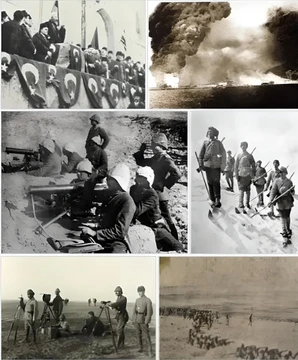
Talaat Pasha
Ottoman leader, convicted war criminal, architect of the Armenian genocide.

via Wikipedia: Talaat Pasha · see source
Mehmed Talât Pasha (1 September 1874 – 15 March 1921), commonly known as Talaat Pasha or Talat Pasha, was a Turkish activist, revolutionary, politician, and convicted war criminal who served as the de facto leader of the Ottoman Empire from 1913 to 1918. He was chairman of the Union and Progress Party, which operated a one-party dictatorship in the Empire; during World War I he became Grand Vizier (prime minister). He has been called the architect of the Armenian genocide, and was responsible for other ethnic cleansings during his time as Minister of Interior Affairs.
- born
- 1 September 1874, Kırcaali, Adrianople Vilayet
- died
- 15 March 1921, Berlin
- field
- Politics, activism
- nationality
- Ottoman Turkish
- known_for
- Architect of the Armenian genocide; de facto leader of the Ottoman Empire 1913–1
Verified Timeline
Lore & Background
Mehmed Talaat was born in 1874 in Kırcaali, Adrianople Vilayet, into a middle-class family of Romani, Turkish, and Pomak descent. His family fled to Constantinople when Russian troops occupied their home during the 1877–1878 Russo-Turkish War, an experience that contributed to his nationalism. After his father died when Talaat was eleven, he was expelled from military secondary school at sixteen after a conflict with his teacher. Without a degree, he worked as a postal clerk in Adrianople and later as a Turkish language teacher at the Alliance Israelite School. He joined the Committee of Union and Progress (CUP) after being arrested in 1893 for a suspicious telegram. Imprisoned again in 1896 for his role in a CUP cell, he was sentenced to three years, pardoned after two, and exiled to Salonika. There he worked as a postal clerk from July 1898, using the position to smuggle dissident newspapers while continuing revolutionary activities. In September 1906 he helped form the Ottoman Freedom Committee, which merged with the Paris-based CUP in September 1907.
Reader's Guide
Talaat Pasha's significance lies in his role as the civilian leader of the Three Pashas triumvirate that ruled the Ottoman Empire during World War I. He is widely considered the main perpetrator of the Armenian genocide, ordering the arrest and deportation of Armenian intellectuals in Constantinople on 24 April 1915 and promulgating the Temporary Law of Deportation on 30 May 1915—events that initiated the genocide and led to the death of around 1 million Armenians. After the Ottoman defeat, he resigned and fled the country on the night of 2–3 November 1918. The Ottoman Special Military Tribunal convicted and sentenced him to death in absentia for subverting the constitution, profiteering from the war, and organizing massacres against Greeks and Armenians. From exile in Berlin, he supported the Turkish Nationalists led by Mustafa Kemal Pasha in Turkey's War of Independence. He was killed in Berlin on 15 March 1921 by Soghomon Tehlirian, a member of the Armenian Revolutionary Federation, as part of Operation Nemesis.
Did You Know?
- Talaat was expelled from military secondary school at age sixteen without a certificate after a conflict with his teacher.
- He worked as a Turkish language teacher at the Alliance Israelite School, which served the Jewish community of Adrianople.
- At age 21, Talaat was involved in a love affair with the daughter of the Jewish headmaster for whom he worked.
- He joined the Salonica Freemason Lodge Macedonia Risorta in 1903.
- Talaat personally negotiated the Treaty of Brest-Litovsk with the Bolsheviks, regaining parts of Eastern Anatolia occupied by Russia since 1878.
Early Life and Formative Years
Mehmed Talaat was born in 1874 in Kırcaali, within the Adrianople Vilayet, into a middle-class family of Romani, Turkish, and Pomak descent. His father, Ahmet Vasıf, was a kadı from Çeplece, a nearby village, while his mother Hürmüz came from a Turkish family that migrated from Dedeler village, Kayseri. When Russian troops occupied their home during the 1877–1878 Russo-Turkish War, the family fled to Constantinople—an experience that contributed to Talaat's nationalism. His father died when Talaat was eleven, putting his mother and two sisters under his care. Talaat had a powerful build and a dark complexion, with gruff manners that caused him to be expelled from military secondary school at sixteen without a certificate after a conflict with his teacher. Without a degree, he joined the staff of a telegraph company as a postal clerk in Adrianople to provide for his family, supplementing his low salary by teaching Turkish at the Alliance Israelite School. At 21 he was involved in a love affair with the daughter of the Jewish headmaster for whom he worked. Under Abdul Hamid II's autocratic regime, Talaat was caught sending a suspicious telegram and confronted by police; he claimed the message was to his dalliance. With two friends from the post office, he was charged with tampering with the official telegraph and arrested in 1893. After release, he joined the CUP. In 1896 he was imprisoned again for being part of a CUP cell with his brother-in-law, sentenced to three years, pardoned after two, and exiled to Salonika, where he became a postal clerk in July 1898. Between 1898 and 1908 he served as a postman, continuing revolutionary activities in secret. Promoted to municipal chief clerk in April 1903, he could afford to bring his mother and sisters to Salonika. His postal job allowed him to smuggle dissident newspapers into the city. That year he joined the Salonica Freemason Lodge Macedonia Risorta and began corresponding with Ahmed Rıza. He met economics professor Mehmed Cavid at Salonika Law School, where he took classes to supplement his education. The government still monitored him, and he was almost exiled again to Anatolia, but Inspector General Hüseyin Hilmi Pasha intervened, and Talaat returned to Salonika to work as a school principal. In September 1906, the Ottoman Freedom Committee (OFC) was formed in Salonika, with founders including Talaat, Dr. Midhat Şükrü, Mustafa Rahmi, and İsmail Canbulat. Talaat served on the Central Committee with Rahmi and Canbulat. Under Talaat's initiative, the OFC merged with Ahmed Rıza's Paris-based CUP in September 1907, becoming the internal center of the CUP. Talaat was briefly secretary-general of the internal CUP, while Bahattin Şakir was secretary-general of the external CUP.
Rise to Power and the Turn to Authoritarianism
Talaat's political ascent accelerated after the 1908 Young Turk Revolution restored the constitution and parliament. During the revolution, Talaat organized a plot to assassinate the Hamidian loyalist garrison commander of Salonika, Ömer Nâzım. Nâzım survived his hired Fedai with injury, but the incident and other CUP assassinations intimidated the Hamidian establishment enough to reopen parliament. Talaat was easily elected as the CUP's deputy for Adrianople and then elected the parliament's deputy-president under Ahmed Rıza. A year later, during the 31 March Incident, an anti-Unionist demonstration turned into an anticonstitutionalist-monarchist counter revolution. Grand Vizier Hüseyin Hilmi Pasha was forced to resign for Ahmed Tevfik Pasha. Dashnak leader Khachatur Malumian hid Talaat and Dr. Nâzım in his house while mob violence targeted MPs. Three days later, Talaat and 100 MPs escaped Constantinople for Ayastefanos (Yeşilköy) to organize a separate national assembly, declaring the change in government illegal. Relief came with the Action Army led by Mahmud Şevket Pasha, which stopped in Ayastefanos before marching on the capital; it was secretly agreed there that Abdul Hamid would be replaced by his brother. After the revolt was crushed, Talaat bullied the Shaykh-al-Islam Sahip Molla to get a fatwa for Abdul Hamid's deposition and convinced Tevfik Pasha to step down, returning Hilmi Pasha to the premiership. With the fatwa, parliament voted to depose Abdul Hamid II. Talaat and Ahmed Muhtar Pasha headed the delegation to announce Prince Reşad's ascension. Multiple crises—the 31 March Incident, attacks on Rumelian Muslims in the Balkan Wars, and the power struggle with the Freedom and Accord Party—made Talaat and the Unionists disillusioned with multicultural Ottomanism and political pluralism, turning them into hard-line authoritarian Turkish nationalists. In 1913, Talaat and Ismail Enver carried out a coup d'état with Mahmud Şevket Pasha as a reluctant partner. With Şevket's assassination, an autocratic triumvirate of CUP Central Committee members led the Ottoman Empire: Talaat, Enver, and Ahmed Cemal (the Three Pashas), with Talaat as civilian leader.
Wartime Leadership and the Armenian Genocide
Talaat and Enver were influential in bringing the Ottoman Empire into the First World War. On 24 April 1915, Talaat ordered the arrest and deportation of Armenian intellectuals in Constantinople (now Istanbul), most of them ultimately murdered. On 30 May 1915, he promulgated the Temporary Law of Deportation. These events initiated the Armenian genocide, for which Talaat is widely considered the main perpetrator, held responsible for the death of around 1 million Armenians. He was also responsible for other ethnic cleansings during his time as Minister of Interior Affairs. In 1917, in a move that established total Unionist control over the Turkish government, Talaat Pasha became Grand Vizier. He personally negotiated the Treaty of Brest-Litovsk with the Bolsheviks, regaining parts of Eastern Anatolia occupied by Russia since 1878, and introduced many social reforms.
Downfall, Conviction, and Assassination
Allied breakthroughs on the Macedonian and Palestinian fronts meant defeat for the Ottomans and the downfall of the CUP, whereupon Talaat resigned. On the night of 2–3 November 1918, Talaat Pasha and other members of the CUP's central committee fled the country. The Ottoman Special Military Tribunal convicted and sentenced him to death in absentia for subverting the constitution, profiteering from the war, and organizing massacres against Greeks and Armenians. Exiled in Berlin, he supported the Turkish Nationalists led by Mustafa Kemal Pasha (Atatürk) in Turkey's War of Independence. He was killed in Berlin on 15 March 1921 by Soghomon Tehlirian, a member of the Armenian Revolutionary Federation, as part of Operation Nemesis.
Frequently Asked Questions
Who is Talaat Pasha?
Born Mehmed Talât Pasha in 1874 in Kırcaali, he was a Turkish revolutionary and politician who rose to become the dominant political figure in the Ottoman Empire from 1913 through 1918. He headed the Union and Progress Party and later took the office of Grand Vizier during the First World War.
What was Talaat Pasha's role in Ottoman politics?
As chairman of the Union and Progress Party, he effectively controlled the government, which operated under a single-party system during his tenure. He also served as Minister of Interior Affairs before ascending to the Grand Vizier position, giving him sweeping executive authority over the Empire.
What is Talaat Pasha most infamously associated with?
He is widely identified as the chief planner behind the mass slaughter of Armenians during World War I, a campaign now recognized as genocide. He has additionally been implicated in the forced displacement and killing of other ethnic groups while he held the Interior portfolio.
How did Talaat Pasha's life end?
Following the defeat of the Ottoman state, he lived in exile in Europe and was shot dead in Berlin on 15 March 1921. His assassination marked the end of a man who had dominated Ottoman politics for roughly five years.
Why is Talaat Pasha still discussed in historical and political contexts?
His leadership period overlaps with the Armenian genocide and other campaigns of ethnic violence, making him a focal point in debates over wartime responsibility and the origins of modern Middle Eastern borders. He remains a polarizing figure viewed by some as a nationalist revolutionary and by others as a mass murderer.
More in Ottoman And Middle Eastern Leaders 1-20
Spotted an error? Know more?
This is a living reference — every entry is fact-audited, and reader corrections feed straight into our audit queue. Suggest an edit · See this site's audit record